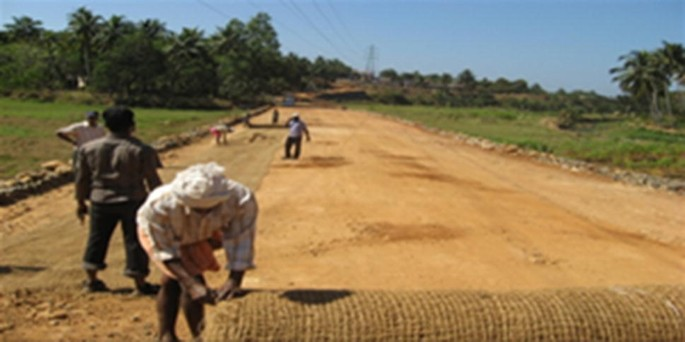

Coir geotextiles in roads– Soil has been used worldwide as a construction material for buildings, roads, irrigation structures, etc. Due to the fragility of resistance to traction and shear, it is necessary to improve the soil according to the needs of the work, which vary from place to place . Soil stabilization has been done for centuries to improve soil engineering properties. The main method of stabilization includes soil mixing with higher strength soil or binding materials such as limestone/cement/calcium or reinforcement with suitable elements/fibre.
Roads built on BC soil bases develop undulations in the road surface due to loss of subsurface strength due to subsidence during monsoons. BC soil is a very clayey soil and is a problem for road engineers. In the dry state, it shrinks and becomes so hard that the strands cannot be easily pulverized for treatment for use in road construction.
Coir Geotextiles in Roads Construction
However, when wet in the rain, it swells, loses power and creates serious road performance issues later on. Break all these fruits on the streets so that the best road engineers build roads. In BC soil, but there is no choice, as black cotton soil is available in about a third of the country. It is often impossible to build a stable base course over a soft subsoil without losing expensive base material that sinks into the soft subsoil; therefore a soil improvement method should be used.
Coconut geotextiles are one of the largest groups of geosynthetic products. One of the most common areas of use for geotextiles is the construction of paths and embankments in soft ground. They are materials in the traditional sense, consisting mainly of manufactured fibers. However, natural fibers are also used for production.
Maybe you like to read the following article Implementing Coir Geotextiles as A Erosion Control Coconut Matting
Application of coconut fiber geotextiles on road surfaces
Coconut geotextiles are produced by crushing the coconut with a grinder to make a small piece of coconut. The coconut fiber is then spun with a spinner to make coconut rope. The coconut rope diameter can be adjusted as needed. After forming the rope, coconut rope is woven to resemble a net. The thickness of this mesh can be adjusted as needed.
The material to make geotextiles from coconut is cheap and easy to find. Geotextile engineering uses coir fibers as an overlay or inner layer for the road. It can protect against run-off water flow and strengthen filling, filtering and draining.
Coconut coir geotextiles or coconut nets are spread directly over the area to be used as roads. First, the ground is roughly leveled, and then coconut netting is spread over it. Coconut geotextiles are another solution for road surfacing as they are made from natural materials. The material is strong, but it can be decomposed by soil. It is safe for the soil’s own ecosystem. It is compared to a mixture of lime, cement, etc.
Improving soil nutrients using coconut geotextiles after decomposition. It is nutritious and beneficial for plant growth. The use of coconut geotextiles on roads in areas of high compression and sloping ground has been successful. It is also used for road embankments and land at risk of erosion and erosion.